Metacognition, thinking about your own thinking, sounds like a classroom concept. In a digital transformation it is very practical. After leading teams in five countries, I have seen the same thing again and again: changes that hold are the ones where people understand how they reason, not only what they are asked to do differently.
This article defines metacognition, shows how it appears inside an organisation, summarises what research actually says about its effects, and suggests how to develop and measure it. Updated in November 2026.
What is metacognition? A simple definition
Metacognition is the awareness and control of one's own thought processes. The term was introduced by the developmental psychologist John H. Flavell in the 1970s, notably in a 1979 article on metacognition and cognitive monitoring.
A simple example: you notice you are getting irritated with a new system, recognise that the irritation is steering how you use it, and choose a different approach. That moment of noticing and adjusting is metacognition.
Research usually distinguishes two components:
- metacognitive knowledge, what you know about how you think and learn, including your strengths and blind spots;
- metacognitive regulation, how you plan, monitor and adjust your thinking while working on a task.
How metacognition shows up in organizations
At work, metacognition is the difference between a team that repeats a project post-mortem every year with the same conclusions and one that changes how it plans. It shows up when people estimate the effort a task needs before starting, choose tools deliberately, check their assumptions before a difficult conversation and review afterwards what worked.
Signs that an organisation has it:
- reviews examine why a decision was made, not only whether the result was reached;
- planning, monitoring and evaluation are routine rather than reserved for crises;
- people can say what they do not know without it counting against them.
Signs that it is missing:
- the same failures recur without anyone tracing their causes;
- teams run on habit and their skills slowly erode;
- confidence in a plan is high precisely where knowledge of the subject is thin.
Why metacognition is critical for digital transformation
Most transformation programmes put their effort into technology and processes. The human side gets a communication plan. Yet every new tool asks people to give up a way of working they know, and to judge, while still learning, whether the new one is better. That judgement is metacognitive work.
Generative AI makes the point sharper. A field experiment published in the Journal of Applied Psychology in 2025 randomly gave 250 employees of a Chinese technology consulting firm access to ChatGPT, or not, during a normal working week. Those with access were rated more creative by their supervisors and by external evaluators, but only if they used strong metacognitive strategies: analysing the task, planning, monitoring their progress and revising their approach. The authors also stress that these strategies can be taught.
The same tool, deployed to the same people, produced gains only for those who knew how to question their own way of using it.
The business impact: what the evidence shows
Precise figures on metacognition inside companies are scarce, and many percentages circulating online cannot be traced to a primary study. What can be documented is more modest, and more useful.
In problem-solving, H. Lee Swanson's 1990 study of schoolchildren found that metacognitive knowledge helped explain performance independently of general aptitude: children with high metacognition and low aptitude outperformed those with low metacognition and high aptitude on the tasks studied. That is evidence from education, not from companies, and should be read as such.
In management, Allan Church showed in 1997 in the Journal of Applied Psychology, across four data sets, that high-performing managers were significantly more self-aware than average performers, measured as the agreement between their self-ratings and their direct reports' ratings.
At company level, a Korn Ferry Institute analysis published in 2015 compared 6,977 self-assessments from professionals at 486 listed companies with stock returns between 2010 and 2013. Professionals at poorly performing companies had 20% more blind spots and were 79% more likely to show low overall self-awareness than those at financially strong firms. This is a correlation drawn from a proprietary tool, not proof of cause, and the data are now more than a decade old.
What lack of metacognition costs organizations
The best-known individual cost is the Dunning-Kruger effect. In 1999 David Dunning and Justin Kruger showed that people with the weakest skills in a domain tended to overestimate their performance the most, partly because the skills needed to do the task are the same ones needed to judge it.
In an organisation this has a familiar shape. A steering committee is most confident about the part of the programme it understands least. Feedback is read as a threat rather than as information. Senior people, who receive the least candid feedback, are the hardest to correct. None of this shows up in a project dashboard until it is expensive.
Practical implementation strategies
Metacognition develops through habits more than through training modules.
For individuals
- Close the day or the week with two questions: what did I learn, and what would I do differently?
- Before a decision, write down the assumption it rests on. Check it later.
- Ask for specific feedback on one behaviour at a time, from people who will be candid.
For teams and organisations
- Add an assumptions review to project reviews, separate from the progress review.
- Run pilots explicitly as learning exercises, with the right to stop.
- Pair any AI deployment with practice in how to question its outputs, as the 2025 field experiment suggests.
These habits are the building blocks of a learning organisation.
Assessment and measurement tools
The most widely used instrument is the Metacognitive Awareness Inventory (MAI), published by Gregory Schraw and Rayne Sperling Dennison in 1994. It has 52 items covering knowledge of cognition and regulation of cognition. It was developed with students, and its adaptations for working adults are less established, so it works better as a starting point for discussion than as a score to manage.
In practice, organisations rely on proxies: self-ratings compared with peer ratings in 360-degree feedback, the quality of project post-mortems, how often plans are revised after a review, and psychological safety surveys. None measures metacognition directly. Together they show whether the organisation is able to notice its own mistakes.
Real-world evidence from the field
The 2025 generative AI experiment is one of the few field studies to test metacognition inside a company. Most other evidence comes from education or from correlations, which is a real limit.
Case studies of large transformations rarely use the word, but often describe the mechanism. At Renault, the decision in 2017 to move business and IT staff into a single digital unit, working in short agile cycles, created in my reading regular moments to review what had been learned. I discuss that example in the analysis of Gartner's digital framework.
Moving forward: a call for authentic leadership
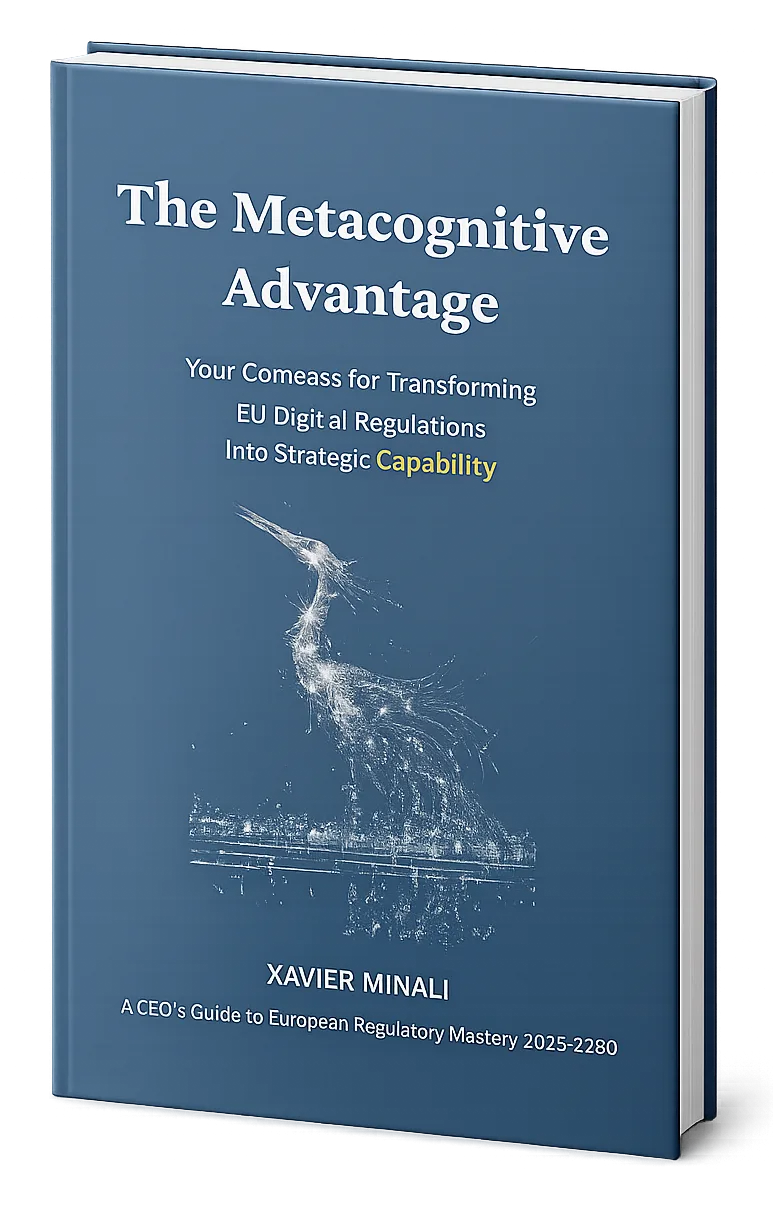
A leadership team does not need a new methodology to start. It needs to make visible the assumptions behind its decisions, invite challenge on them, and treat the answers as information. The RESONANCE™ framework builds this into transformation work from the first assessment, and the book The Metacognitive Advantage develops the leadership side in more depth.
A useful first step is to see where your organisation stands today.
Assess your transformation readiness
Sources
All URLs below were opened and checked in November 2026. Most of the research on metacognition comes from psychology and education; studies inside companies remain rare.
Foundations
- Flavell, J. H., Metacognition and cognitive monitoring, American Psychologist, 1979
- Kruger, J. and Dunning, D., Unskilled and unaware of it, Journal of Personality and Social Psychology, 1999
- Swanson, H. L., Influence of metacognitive knowledge and aptitude on problem solving, Journal of Educational Psychology, 1990
Workplace research
- MIT Sloan, Does generative AI actually enhance creativity in the workplace?, 23 June 2025
- Tulane University, How and for whom using generative AI affects creativity: a field experiment (Journal of Applied Psychology)
- Church, A. H., Managerial self-awareness in high-performing individuals in organizations, Journal of Applied Psychology, 1997
- Korn Ferry Institute, study on self-awareness and company financial performance, 15 June 2015