Picture three budget requests landing on the same executive committee within a few months. Finance asks for the e-invoicing platform. IT asks for AI Act compliance tooling. Legal flags eIDAS 2.0 and digital identity. Three projects, three budgets, three steering committees, and largely the same data underneath.
In 2026 this was not a thought experiment. French mandatory e-invoicing, the EU AI Act and eIDAS 2.0 all reached key dates within the same twelve months, and most organisations treated them as separate IT projects. They are better read as one stress test of how well the organisation coordinates across its own boundaries. Updated in November 2026.
The Hidden Cost of Fragmentation
Three regulations, three different owners, and largely the same raw material: customer and supplier identities, transaction data, audit trails.
- E-invoicing: since 1 September 2026, every VAT-registered company in France must be able to receive electronic invoices through a state-approved platform; large companies and mid-sized companies (ETIs) must also issue them, and SMEs follow on 1 September 2027.
- The AI Act: most of Regulation (EU) 2024/1689, including its transparency obligations, has applied since 2 August 2026; the high-risk obligations were pushed to 2 December 2027 by Regulation (EU) 2026/1744.
- eIDAS 2.0: Regulation (EU) 2024/1183 requires every member state to offer a European Digital Identity Wallet by the end of 2026, with acceptance obligations for many private services to follow.
A French mid-sized manufacturer, with about €120 million in revenue and 400 employees, discovered the friction during its e-invoicing pilot. Accounts payable processed invoices with one data model, procurement with another, sales with a third, and the platform could not reconcile them. The software worked; the organisation had never agreed on what an "invoice" meant across its own functions. Six months after a €340,000 investment, adoption stood at 23%.
The diagnosis was not technical: three departments, three "sources of truth", no shared vocabulary. The learning organisation article describes this as an organisational nervous system that never connected.
Why Regulatory Convergence Is Your Forcing Function
Convergence creates a choice between two logics:
- Compliance logic assigns each text to a department: Finance handles e-invoicing, IT the AI Act, Legal eIDAS 2.0.
- Operational reality requires cross-functional work on shared data models, joint audit trails and one change management effort.
Most mid-market organisations choose compliance logic because it preserves each department's control. That is the "IT fallacy": treating regulatory transformation as a technical implementation rather than a coordination capability.
Convergence forces the diagnosis. Can your departments coordinate when it matters, or do they protect their territory even when that guarantees a worse result for everyone? The wider picture of overlapping deadlines is laid out in the article on the triple technical debt.
The RESONANCE™ Solution: Three Foundation Phases
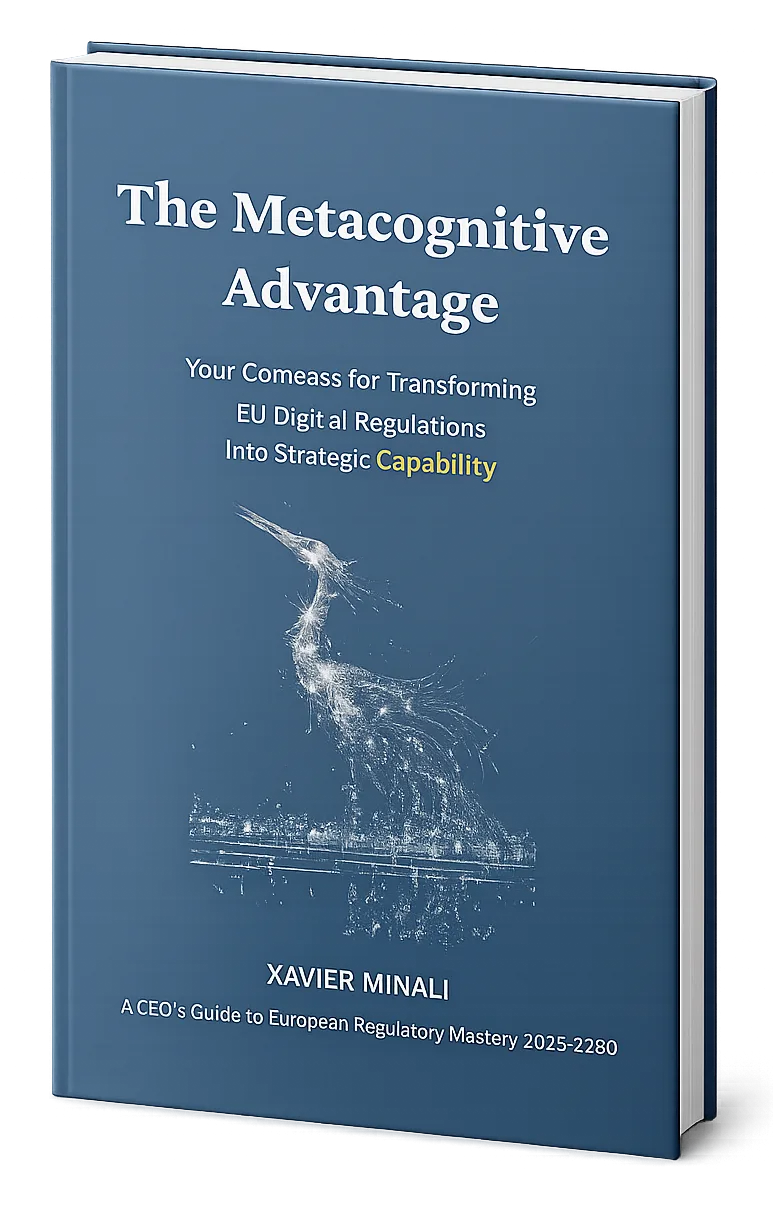
The RESONANCE™ framework, set out in chapter 7 of The Metacognitive Advantage, starts with three foundation phases that build coordination before any technical deployment.
Phase 1: Audit
Purpose: map how the organisation actually coordinates, not just where it is non-compliant.
- Identify where Finance, Procurement, Sales and IT coordinate today, and where they fail to
- Compare real escalation times with the documented ones
- Check whether departments share a common data vocabulary
Deliverable: a convergence readiness map showing cross-functional friction points.
Phase 2: Scoping
Purpose: define one transformation perimeter instead of three projects.
- Set up a single programme covering e-invoicing, the AI Act and eIDAS 2.0
- Identify shared data models: customer identity, transaction metadata, audit logs
- Create one governance structure with cross-functional authority
Deliverable: a programme charter signed by Finance, IT, Legal and Operations. Technical scopes can differ between the three texts; governance stays single.
Phase 3: Boundaries
Purpose: make coordination safer than isolation.
- Define a pilot perimeter where experimentation is protected
- Set escalation rules that do not depend on hierarchy
- Write down how decisions are made when the stakes are high
Deliverable: a covenant stating which behaviours are rewarded and which are not. Teams raise friction early only when doing so carries no blame; otherwise problems surface when they are already failures.
What You've Discovered
If your organisation handled the 2026 deadlines as three separate compliance projects, it has learned something about itself: it has compliance processes but limited coordination capability.
Regulation does not create that gap; it exposes it. The organisations that come through convergence well are not the ones with the largest budgets, but the ones that use mandatory compliance to build a capability they will need again. For e-invoicing specifically, the practical steps are in the French e-invoicing compliance checklist.
Take Action
The full RESONANCE™ method, with templates for the governance charter and the coordination diagnostic, is in The Metacognitive Advantage. To see where your own organisation stands, start with the free assessment.
Assess your convergence readiness
Sources
Sources consulted for this article, list updated in November 2026.